Torev Motors Demonstrates Oil-Cooled Axial Flux Wound-Rotor Motor
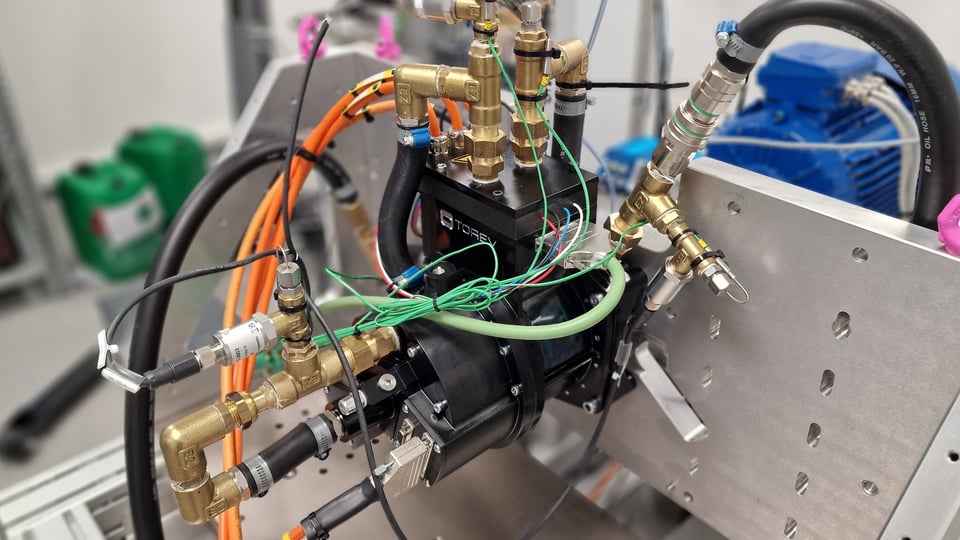
Prototype achieves TRL 4; measured performance matches simulation within 10%, validating a magnet-free path for automotive and defense traction motors and generators.
ARLINGTON, Va., Aug. 14, 2026 — Torev Motors, a developer of rare-earth-free electric motors for automotive and defense markets, today announced that its oil-cooled axial flux prototype has completed independent third-party testing. Measured performance correlated with the company’s electromagnetic and thermal simulations within 10% across key metrics, bringing the technology to Technology Readiness Level 4 (TRL 4). With this achievement, the team has begun developing a 150 kW prototype to mature this technology to TRL 5 by Q2 2027.
The motor contains no permanent magnets and no rare earth elements — no neodymium, no dysprosium, no samarium. Built with engineering support from Alvier Mechatronics, an engineering design consultancy based out of Helsingborg, Sweden, it is a scaled representative of the architecture Torev is developing for automotive traction applications, and the company believes it to be the first oil-cooled, dual-stator, single-rotor axial flux wound-rotor machine ever built and submitted to third-party testing.
“There’s a lot of talk about magnet-free motors right now” said Rory Brogan, Founder and CEO of Torev Motors. “Ours is on a dynamometer, in Germany, getting tested by people who don’t work for us, and it landed within 10% of what we predicted.”
What Torev Built
Torev’s oil-cooled wound-rotor axial flux machine utilizes active, direct cooling of the rotor and stator coils and is compatible with automotive grade dielectric oil coolant used in hybrid and fully electric vehicle powertrains today. Crucially, Torev’s innovative design enables peak performance without inducing parasitic drag losses at the rotor or a significant coolant pressure differential across the unit. Ongoing testing will demonstrate the true bounds of this design while these results inform the development of prototypes of greater mechanical output.
For Torev’s engineering team, the correlation figure is the most consequential result. “Achieving simulation correlation within 10% shows that we have command of the underlying physics of this novel motor architecture,” said Kenny Brown, Ph.D., Director of Engineering at Torev Motors. “Now that we can predict how a given design will perform, we can scale this technology with confidence and proceed with further innovations to realize the full potential of wound-rotor axial flux machines.”
Testing was conducted by PID Test & Engineering GmbH (“PID”), an independent motor test facility in Sand am Main, Germany.
Why a Magnet-Free Motor Matters Now
Automotive and defense manufacturers face acute exposure to rare earth supply risk. China controls the overwhelming majority of global rare earth separation and sintered-magnet capacity, and the export-control measures introduced in 2025 turned that concentration from a long-range strategic concern into an immediate operational one. Industry analysts expect rare earth supply bottlenecks to persist through 2026. For OEMs and defense primes whose traction motors depend on neodymium and dysprosium, near-term alternatives are scarce.
The industry response has been to revisit externally excited (wound rotor) synchronous machines, which replace permanent magnets with a wound rotor of conventional copper. Several global OEMs have brought radial flux versions of this architecture into production. Torev’s work extends the approach to axial flux — a geometry that offers substantially higher torque and power density, but one that has historically resisted wound-rotor implementation due to the difficulty of getting heat out of a spinning, current-carrying rotor. Torev’s oil-cooled rotor is the company’s answer to that problem, and it is the subject of several of its patent filings.
Path to 150 kW
With TRL 4 achieved, Torev is building a 150 kW machine sized for full automotive traction duty. Initial prototypes are expected to complete testing in Q2 2027. The company holds two issued U.S. patents and two pending applications covering its motor topology, rotor cooling strategy, and control architecture.
Torev has completed a $250,000 U.S. Army SBIR Phase I award for a defense-focused variant and is in active discussions with automotive OEMs and Tier 1 suppliers.
About Torev Motors
Torev Motors develops rare-earth-free electric motors for automotive and defense markets. Founded in 2022 and headquartered in Arlington, Virginia, with engineering operations in Charlottesville, Torev’s mission is to eliminate the electric motor’s dependence on rare earth supply chains without sacrificing performance.
Editor’s note: High-resolution images of the prototype, the test setup, and a summary of the third-party test report are available on request. Technical inquiries from OEMs, Tier 1 suppliers, and defense primes are welcome to contact us torevmotors.com.